UpDoc: The Future of Autonomous Clinical Care
Stories
Stories 25.06.26
Backing the team building the first FDA-cleared agentic Clinical AI, and why it points to the next decade of medicine
By: Elijah Yi; Edits: Jaclyn Hartnett
Read on Medium
Today, Palo Alto-based UpDoc became the first company to receive FDA clearance for a Software as a Medical Device built on patient-facing large language models — the first agentic Clinical AI platform to clear that bar. The company also announced $18M in seed financing and initial deployments at four of the nation’s leading health systems. At Cathay Innovation, we’re proud to share that we are investors in UpDoc (investing at seed last year), and prouder still to see this team do what very few in this space have managed.
We decided to back this company from the seed stage because we believed in the larger vision early: a new model for healthcare built on Clinical AI.
This is a meaningful moment, and not only for UpDoc. When we wrote about Clinical AI back in 2024, we argued that the most important applications of AI in healthcare would eventually move past the back office and into care itself. UpDoc is not simply software that assists a physician. It is the first model of genuine clinical action by AI, extending the reach of doctors and amplifying what they are able to deliver to patients. It is the first mover in turning AI into true agents of care. Working under the direct supervision of physicians, the platform deterministically delivers care on their behalf, from monitoring and medication adjustments to lab coordination and documentation.
But before we dig deeper into UpDoc, a word on why we think this moment is bigger than any one company.
The Thesis: AI as an Extension of the Clinician
In our 2024 piece, Healthcare Transformed: Where AI Meets Clinical Care, we laid out a simple view. The first wave of healthcare AI would prove itself on administrative work, scribing, coding, prior authorization, and revenue cycle, because those use cases carried clear ROI and lower risk. But the lasting prize was always on the clinical side, helping clinicians make faster, better-informed decisions and extending their reach to more patients.
Two years later, that thesis on Clinical AI has only sharpened. Here is how we think about it today.
We have a shortage of clinicians, and AI is the natural extension of the clinician. The US is staring down a projected shortfall of up to 86,000 physicians by 2036, driven by an aging population and a training pipeline that cannot keep pace. You cannot hire your way out of this. The only way to meaningfully expand access is to give each clinician more leverage. AI is the most powerful lever we have seen, not as a replacement for the physician, but as an extension of one. The provider remains the scarcest and most valuable resource in the system. The goal is to multiply their reach, not route around them.
Care should involve determinism and be prescribed by the clinician responsible for the patient. This is the part the market often gets wrong. You need to build something that understands guidelines, protocols, and the explicit judgment of the physician who owns the patient relationship. The right model is an AI that executes care a clinician has prescribed and supervised, every time, in a way that is bounded and auditable. This is what separates a demo from a device.
Better care comes from AI that improves the actual touchpoints with patients rather than the paperwork around them. Scheduling, outreach, and revenue cycles are real problems, and we have backed companies solving them. But the patient does not feel a faster billing cycle. They feel whether anyone checked on them between visits, whether their medication got adjusted when their numbers drifted, whether someone caught the problem early. The highest-value AI is the kind that does real healthcare work in the gap between appointments, where most chronic disease is actually won or lost.
Care at the cost of tokens. This is the part that should reshape the economics of the system. Today, every incremental touchpoint with a patient carries the cost of human labor, which is why so many patients go unmonitored between visits. When a meaningful share of clinician-directed care can be delivered through software, the marginal cost of an additional patient interaction collapses toward the cost of compute. That is how you get from rationed care to abundant care: by changing what each dollar buys.
The future we are underwriting is one where clinicians prescribe care and AI delivers it, at the cost of tokens instead of the cost of services.
Enter UpDoc.
If you were going to design a company to deliver on that thesis, it would look a lot like UpDoc.
UpDoc was founded by clinicians, not technologists who later hired a medical advisor. CEO Sharif Vakili is a practicing primary care physician and Clinical Assistant Professor at Stanford, with an MD from Johns Hopkins, an MBA from Harvard, and degrees in biology from Yale. CTO Ashwin Nayak is a practicing hospitalist and board-certified clinical informatician at Stanford, and a published AI researcher in journals including JAMA Internal Medicine and Nature Digital Medicine. They have been building together for years and started UpDoc because they lived the gap firsthand: what medicine knows how to do vs. what the system is actually able to deliver.
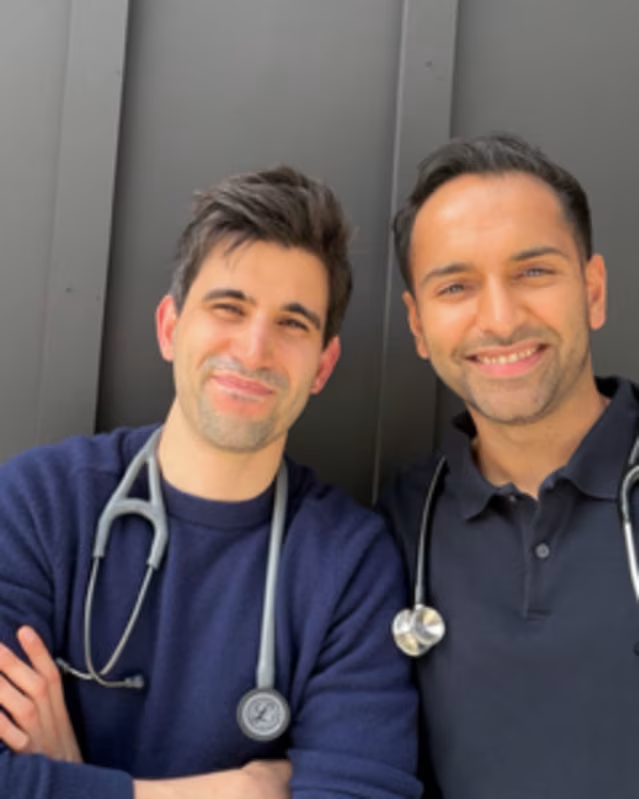
Sharif and Ashwin understood something that is easy to miss from outside the clinic. Healthcare does not get transformed by wrapping a chatbot around a language model. It gets transformed by software that is:
- deeply integrated into the clinical ecosystem
- fits into the EHR and the clinician’s existing workflow (rather than sitting beside it)
- held to the standard of a regulated medical device
They chose the hard path on purpose, because it is the only one that leads to real care.
The product reflects that conviction. Where most healthcare AI stops at outreach, scheduling, and billing, UpDoc was purpose-built as a clinical operating system embedded directly into provider workflows. At its core is UpDoc Clinical Intelligence, a proprietary orchestration and safety architecture that unifies clinical guidelines, longitudinal patient context, physician governance, and EHR data, then coordinates and executes real-world care at scale. Once a clinician sets the parameters, the platform can carry out the interventions that used to require a physician’s direct, hands-on involvement: adjusting medications, facilitating lab orders, coordinating with care teams, and documenting all of it.
–> Consider a patient with Type 2 diabetes whose blood glucose has been drifting out of range. UpDoc identifies the trend, initiates a titration of the patient’s insulin within physician-approved parameters, triggers the right follow-up test to confirm safety, and documents the full intervention in the EHR, all without the patient ever needing to schedule an appointment. That is not a recommendation engine hedged behind a disclaimer. That is care.
It is also a direct expression of how Sharif frames the opportunity. Clinical AI, he argues, should be held to the highest standard, and this clearance opens a new era where, in his words, clinicians will be able to deploy Clinical AI agents to help complete tasks autonomously on their behalf, much like engineers deploy coding agents today. We find that analogy exactly right. The clinician stays in command and sets the bounds. The agent does the work.
The early evidence is what gives us confidence the model holds up. UpDoc’s platform grew out of a landmark Stanford trial published in JAMA Network Open, in which 81% of Type 2 diabetes patients reached target glucose levels versus 25% under standard care. And the deployments are no longer hypothetical. UpDoc is rolling out at premier health systems including Cleveland Clinic, Allegheny Health Network, and UCSF Health, with broader expansion underway.
The financing reflects the same caliber of conviction. The $18M seed brings together leading healthcare investors and strategic partners, including the American Diabetes Association, us at Cathay Innovation, Lilly Ventures, Mayo Clinic, Oxeon, Pear VC, Polaris Partners, and Section 32. Rarely do you see operators, payers, pharma, and disease foundations line up behind the same company, speaking to how broadly the need is felt.
Our Conviction.
We are still in the early innings. But what separates UpDoc from the rest is that the clearance is real, the evidence is real, and the deployments are real. This is not a vision deck. It is a cleared platform, with results behind it and health systems in front of it, built by physicians who can sit across from a CMO and be trusted with the hardest part of the job.
What gets us most excited is where this goes. UpDoc did the difficult work of clearance and integration, and in doing so, it has defined what it looks like to build Clinical AI responsibly. As the underlying models keep getting better and cheaper, UpDoc owns the layer that compounds: the clinical logic, the workflow integration, the regulatory standing, and the trust. Every turn of that curve lowers the cost of delivering another unit of clinician-directed care.
Ultimately, we see a world where AI creates an abundance of care, prescribed and supervised by clinicians, delivered at a fraction of today’s cost, and reaching the millions of patients who currently fall through the cracks between visits. That is a healthier population and a lighter burden on a system buckling under its own expense. It is the future of autonomous care, and we believe UpDoc is building it.
We could not be more thrilled to back Sharif, Ashwin, and the entire UpDoc team, alongside an exceptional group of co-investors, on this journey.
NEWS