Investing in the open-source model that reached the frontier
On January 27, 2026, a research lab out of Beijing released a new model, a technical report, and a set of benchmark scores that, if you knew what to look for, told the whole story.
Within twenty days, Kimi K2.5’s monthly revenue had exceeded what the company earned in all of 2025. Revenue doubled every month after that.
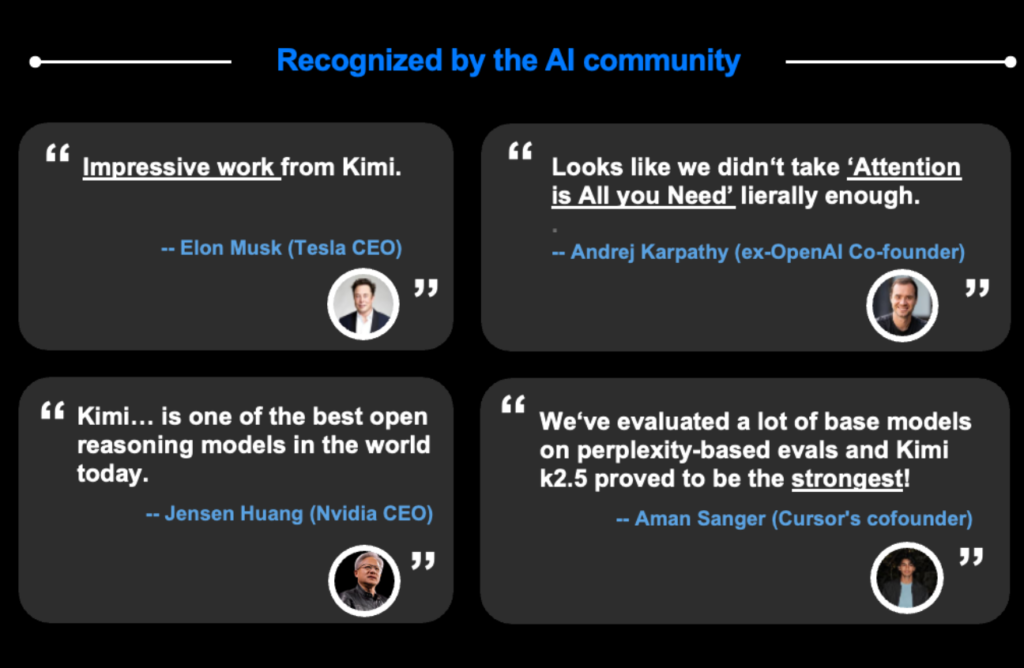
When Kimi published new research on a foundational architecture innovation, Elon Musk weighed in: “Impressive work from Kimi.” Days later, Cursor shipped Composer 2, powered by K2.5 underneath. Musk’s response: “Yeah, it’s Kimi 2.5.”
At Cathay Innovation, our team has known Moonshot AI since its seed round. So when the conditions were met, it took just ten minutes for our investment committee — partners from around the world — to reach a decision. It was unanimous. We’ve doubled down since, a second tranche, then a third.
Today, with revenue doubling every month and K2.5 leading global benchmarks in coding and agentic reasoning — and Bloomberg reporting its latest round at a nearly $20B valuation (and another raise underway)— we’re sharing the reasoning behind our investment in the open-source model that reached the frontier.
A Cost Story: The Open Vs. Closed Debate
For two years, a version of the same argument played out across the LLM market: could open-source models actually reach the frontier, or would the gap between open and closed widen indefinitely as frontier labs poured in capital?
K2.5 settled it. The model leads open-source on agentic and search benchmarks, is competitive with the best closed-source models on coding, and costs roughly one-fifth of leading closed source models per token at comparable performance. This matters now more than ever: the world is hungry for AI, but scrutinizing the price.
The cost story here is key. The constraint has shifted. A year ago, the question was whether enterprises would adopt AI at all. Today, it’s whether they can afford to keep using it. Costs are scaling faster than budgets, , and without traditional software spend control mechanisms, major public companies are blowing through their full-year AI spend in a matter of months.
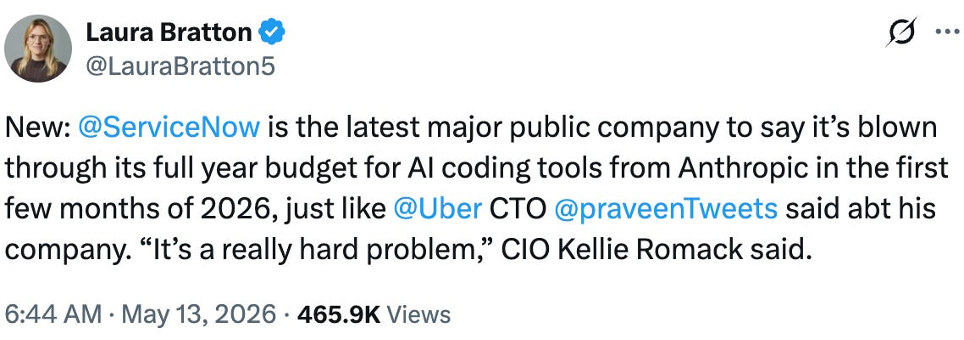
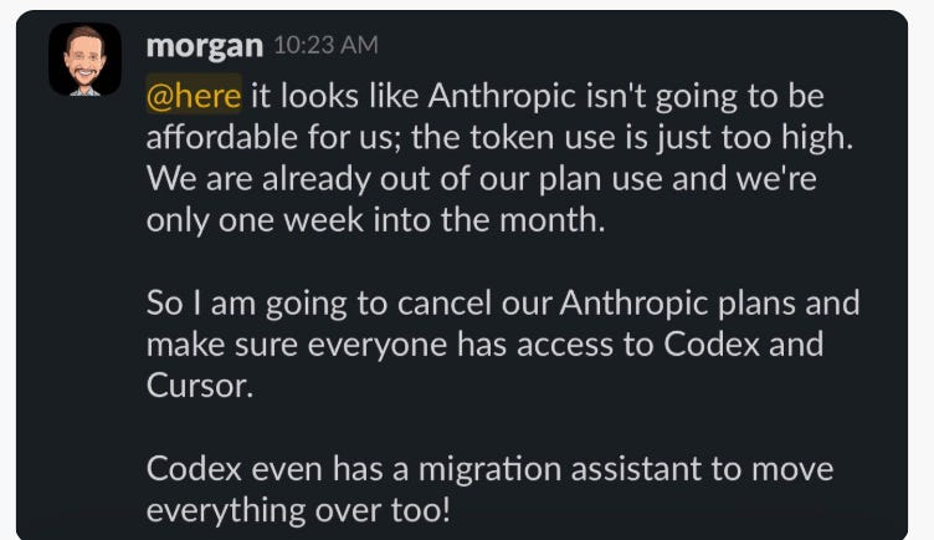
Kimi’s cost advantage is structural, built up from architectural choices made at every layer of the stack. Its Mixture-of-Experts architecture activates only a fraction of the model’s parameters per query, reducing the compute demand per inference. Its custom serving infrastructure dramatically improves how efficiently those queries are cached and reused. Its in-house training optimizer achieves roughly twice the token efficiency from the same training data. These compound. The result is frontier-level performance at a fraction of the cost.
Constraints, it turns out, produce innovation.
The broader picture is still early. Today, 84% of the world has never used an LLM. Paid AI users are a rounding error at global scale. Token consumption for coding and agentic workflows is growing exponentially. The model best positioned to serve that growth is, on current evidence, the most efficient one. Closed models still matter — for the highest-stakes tasks, the frontier labs earn their price. But “good enough at one-fifth the cost” is a different and larger opportunity than peak performance for the few.
Open source also matters more than it did a year ago: enterprises and governments increasingly want models they can audit, deploy, and genuinely trust. Kimi open-sources its original work deliberately — to earn community trust, attract talent, and generate the kind of independent validation no marketing budget can buy.
Enter Kimi.
Moonshot AI was founded in May 2023 by Zhilin Yang, lead author of Transformer-XL and XLNet, two of the papers that shaped how modern language models are built. Yang completed his PhD at Carnegie Mellon, then joined Google Brain, eventually moved to Meta AI, and later founded a company to push the absolute limits of intelligence. What the résumé doesn’t capture: this team builds its own architectures from scratch.
The proof is in the research. MuonClip, first deployed at trillion-parameter scale, doubled training efficiency. Kimi Linear introduced a new attention architecture with 6x higher decoding efficiency at long context lengths. Attention Residuals rethinks how neural networks aggregate information across layers. Each was open-sourced, peer-reviewed, and independently validated. Jensen Huang called Kimi “one of the best open reasoning models in the world.” The company was featured at NVIDIA GTC in March 2026, a stage reserved for companies pushing the technical frontier.
The commercial momentum followed the model. K2.5 is the backbone of Cursor’s Composer 2. It powers coding products used by Baidu, Alibaba, and Tencent. Other customers who’ve made the switch: Notion, Coinbase, Coursera and Perplexity. Globally, enterprise API demand is oversubscribed. The only ceiling on revenue growth right now is compute access.
Since K2.5, Moonshot has continued to ship: K2.6 extended agentic capabilities further; K2.7 took coding performance to a new level. K3 is on the horizon.
Kimi’s ARR has tripled in the three months since March, driven by surging developer adoption and API revenue powered by rapidly advancing model capabilities. Global leaders are already using the Kimi model, while the company’s partnerships with trusted local firms ensure strict data compliance.
Our Conviction.
Years of proximity give you something a data room never shows: the quality of thinking behind the decisions. Since the start, our team has watched every model release, every architecture paper, every commercial decision, and waited for a clear winner before committing. K2.5 was the signal.
Our investment committee came to that conclusion from different angles:
- This is the best open-source foundation model on the market, built by a team that has consistently out-researched and out-architected the competition.
- The performance-to-cost equation is a structural wedge into enterprise AI spend, and K2.5 is best-positioned to capture it.
- And for enterprises and governments navigating an increasingly complex regulatory environment, an open-source model with genuine technical independence — auditable by design, deployable on local infrastructure — answers a question that closed models can’t.
The data residency question comes up in every enterprise conversation. Kimi’s answer is operational, not political. Deploy the model locally through a regional infrastructure partner, and the data never leaves the country. Kimi’s team has walked that conversation with compliance officers at some of the largest companies in the US and Europe. It holds up.
What’s Next.
At Cathay Innovation, our position at the intersection of China, Europe, and the United States is central to this investment. After closing, we introduced Kimi to a set of European partners to begin exploring deployment and collaboration opportunities. Kimi’s ambition is global. Our job is to make that ambition shorter to reach.
Kimi is not an isolated example for us. Our portfolio includes companies building at the foundational level of AI — Bioptimus (foundation model for biology), AMI Labs (world model AI), Logical Intelligence (energy-based models for critical systems), just to name a few. We keep investing here because the infrastructure layer is where the transformation of industries and society begins. What’s become clear: huge markets are open for companies building models genuinely at the frontier and these companies are changing businesses in ways we never imagined.
The gap between open and closed models is narrowing faster than most people expected. The assumption that frontier capability requires frontier budgets no longer holds. What Kimi demonstrates is that regardless of geo, a talented team doing rigorous architecture work can reach near the same performance level at a fraction of the cost. The open-source model is the distribution strategy: equal access, independent validation, global reach.
Moonshot AI has raised approximately $5B across its closed funding rounds since founding. Other leading frontier labs have raised tens of billions of dollars each. The gap in funding has not produced a gap in capability. That capital efficiency has two sources:
- A team that decided, from the beginning, the path to AGI runs through better architecture, not bigger budgets.
- The strength of open source, a global research community collaborating to build the most capable and most transparent AI in the world.
We are proud to back the Moonshot AI team on their mission to build cutting-edge, affordable AI that is not a black box — where open source becomes the enabler of a sovereign tech stack across every geography.