The Pragmatic Robotics Boom
What 135 investors, founders, and operators believe about the next decade of Physical AI

For most of the last decade, the robotics pitch ran on promise. Now, the economics are finally catching up: component costs crashing, edge compute delivering order-of-magnitude gains in performance per dollar, and wages in the sectors most exposed to automation continuing to climb.
We mapped out how we got here in our March piece: The Industrialization of Embodied Robotic Intelligence
The aggregate of these trends has created fertile ground for the current wave of robotics interest. Yet, we are still in the early innings. The vaunted intelligence layer and the various architectures being explored are still closer to demo than to full commercialization. The data backing them is still nascent, with roughly 300,000 hours of robot manipulation data globally against something on the order of a billion hours of internet video. And integrating into the real-world environments where customers are actually seeking autonomy still takes a great deal of hands-on work.
From our initial analysis, we took it a step further – we wanted the view from the people actually building this. In May, we surveyed 135 practitioners from across the ecosystem: investors writing the checks, founders and engineers building the systems, operators running live deployments, and academics doing the underlying research to get the ground truth on what is and isn’t the case:
–> Will robotic foundation models have their ChatGPT moment and reach the valuations of the major LLM labs?
–> Is the hype around humanoids justified?
–> Will anything actually be folding our clothes before the decade is out?
Interest in robotics looks to be at an all-time high, and our respondents agree: investors, founders, operators, and academics alike returned a median optimism score of 5 out of 5 on where the market is headed over the next five years. But Robotics has never been a single race with a single leaderboard, and respondents don’t expect it to become one. Different geographies show distinct areas of strength: China leads on hardware and manufacturing scale while the US retains an edge on the intelligence layer, a split most expect to persist through 2030. That kind of nuance gets flattened when the conversation collapses into a handful of marquee companies and demo videos (like Figure’s eye-watering $39B valuation, or the impressive dexterity–focused models displayed by Physical Intelligence, Generalist, and Eka).
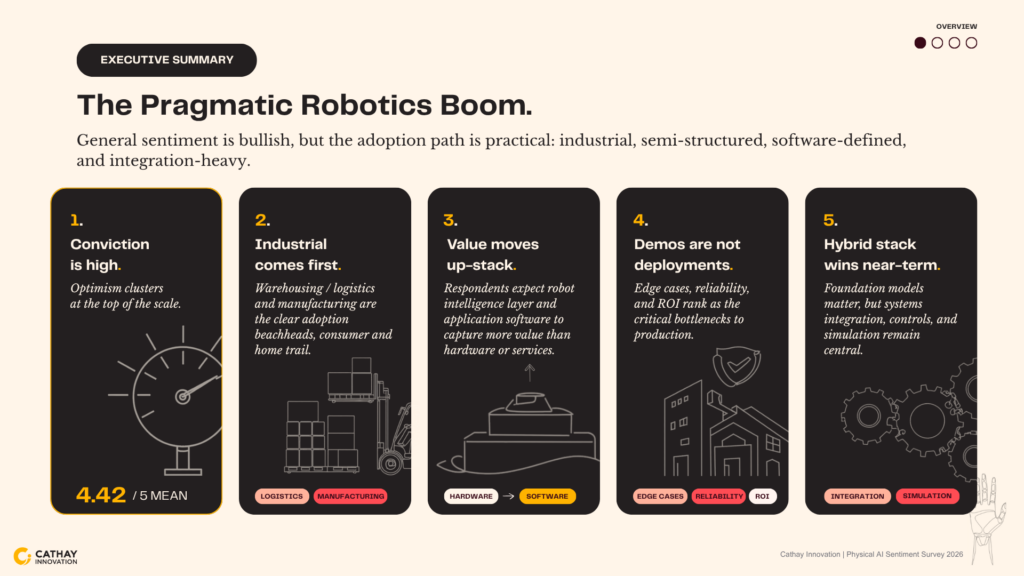
Our survey confirmed some real divergences (and alignments) between what the market assumes and what those in the arena believe, five of which we feel are critical to highlight below:
* Conviction is high. Optimism clusters at the top of the scale, though investors are measurably more cautious than the people building.
* Industrial comes first. Warehousing, logistics, and manufacturing are the clear beachheads, with consumer trailing by a five-year gap.
* Value moves up-stack. Respondents expect the intelligence layer and application software to capture more value than hardware, OEMs, or services.
* Demos are not deployments. Edge cases, reliability, and ROI rank as the binding constraints. Regulation ranks last.
* Hybrid stack wins near-term. Foundation models matter, but integration, simulation, and controls remain central to anything that actually ships.
1. Conviction is high.
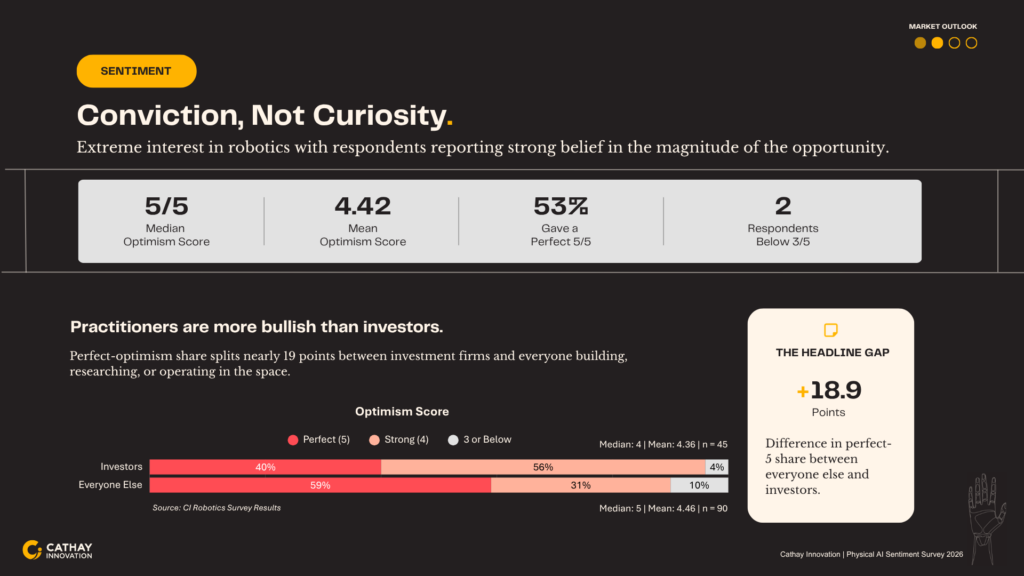
The headline number – a mean optimism score of 4.42 out of 5, with 53% of respondents giving the market a perfect 5 and only two respondents landing below a 3. It seems that while robotics used to have people’s curiosity, it now has everyone’s attention.
That said, it’s not an even split. Investors gave a perfect 5 just 40% of the time, versus 59% for everyone else building, researching, or operating in the space (a nineteen-point spread). The people closest to the capital are, on net, the most conservative voices in the room, even as that same capital is pouring in at a record pace. Worth considering given who’s setting the price in these early innings.
The signal: the market isn’t uniformly euphoric. The builders are displaying more optimism than the people funding them, which is somewhat counter to what you’d expect from a hype cycle.
2. Industrial comes first.
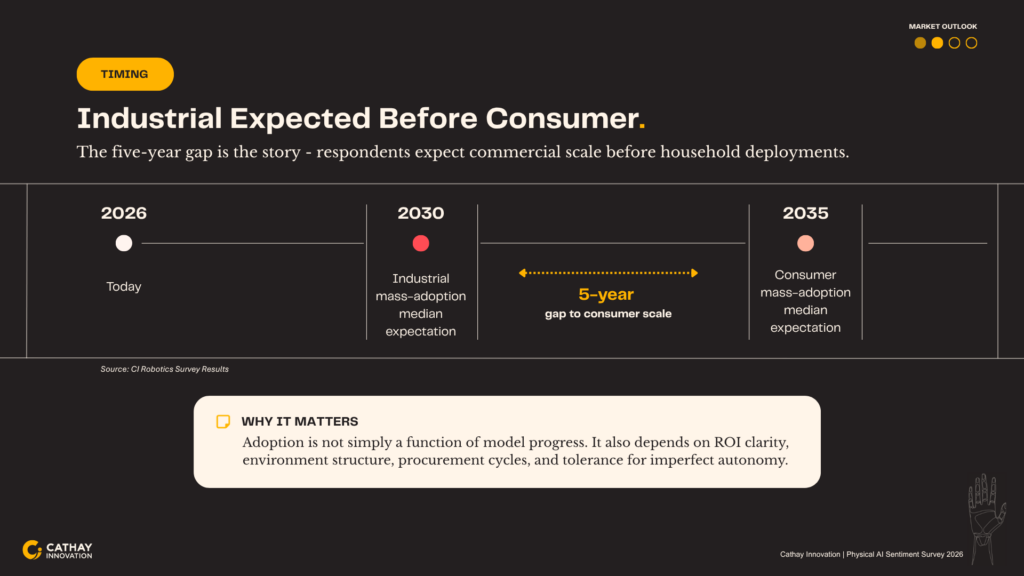
While not particularly shocking, respondents ranked industrial before consumer for commercialization; however, the size of the gap is worth mentioning. Warehousing, logistics, and manufacturing emerge as clear near-term beachheads for adoption while consumer and home robotics trail by a wide margin. Still, both categories remain a few years out with respondents expecting industrial robotics to hit mass adoption around 2030, a full five years ahead of consumer.
The logic underpinning this difference is quite simple – economics. Warehousing carries a mean annual wage near $46K and the highest injury rate of any sector we compared, with manufacturing sitting close behind on both counts. The ROI on automation here is far shorter and more tangible than the calculus around how much we value our time folding clothes at home. perception we hear is that labor-scarcity has powered a lot of the initial warehousing automation push (given the measurable spike in 2021 and 2022). That spike has since normalized, and job openings in the sector have largely returned to a balanced market. That said, the cost and safety logic hasn’t gone anywhere (as noted in the full report by sector) but the labor availability argument looks considerably weaker in 2026 than in the immediate post-COVID years.
The signal: the industrial case is under-hyped relative to how solid the underlying economics actually are, and it isn’t a labor-shortage story anymore so much as a cost-to-serve one.
3. Demos are not deployments.
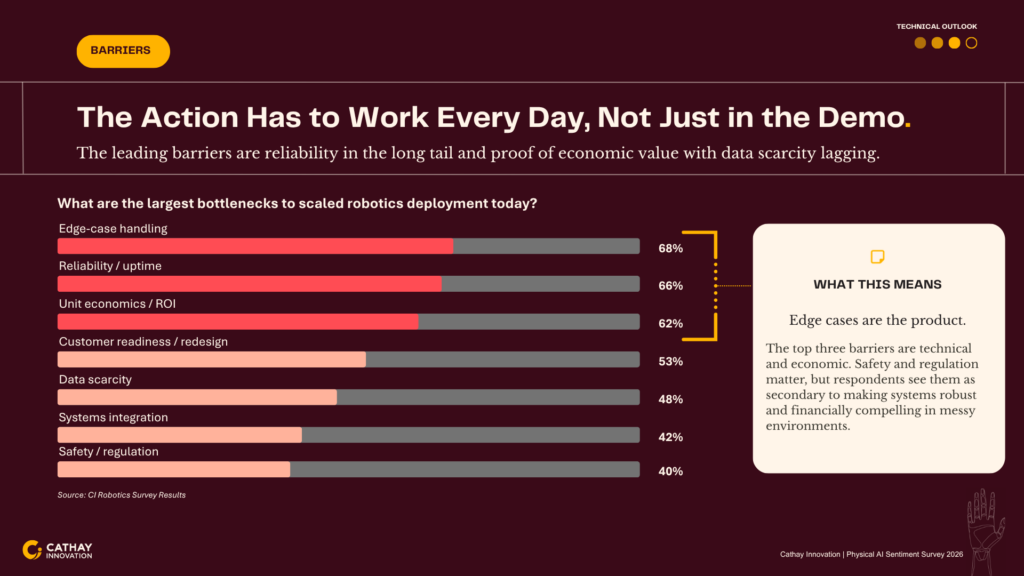
Ask most outsiders what’s slowing robotics down and you’ll usually hear about the endless edge cases plaguing full deployment. Well, practitioners largely agree! Edge-case handling (68%) and reliability and uptime (66%) top the list of deployment bottlenecks, with unit economics and ROI close behind at 62%. Safety and regulation rank last of the seven options we tested, at 40%, a full 28 points behind the top concern likely due to needing to see further deployments first, before this can come into focal concern.
That ordering tells you where the real work is. The barrier doesn’t stop at getting a robot to work in a demo or a controlled task. It’s getting it to work every day, in a messy commercial environment, at a cost that pencils out with high reliability. So what starts as a research problem quickly morphs into a systems and engineering problem before it’s a policy problem (sorry Elon, we might need to call in the systems engineers here!).
The signal: the constraints are technical and economic, keeps robotic deployments stalled.
4. Value moves up-stack.
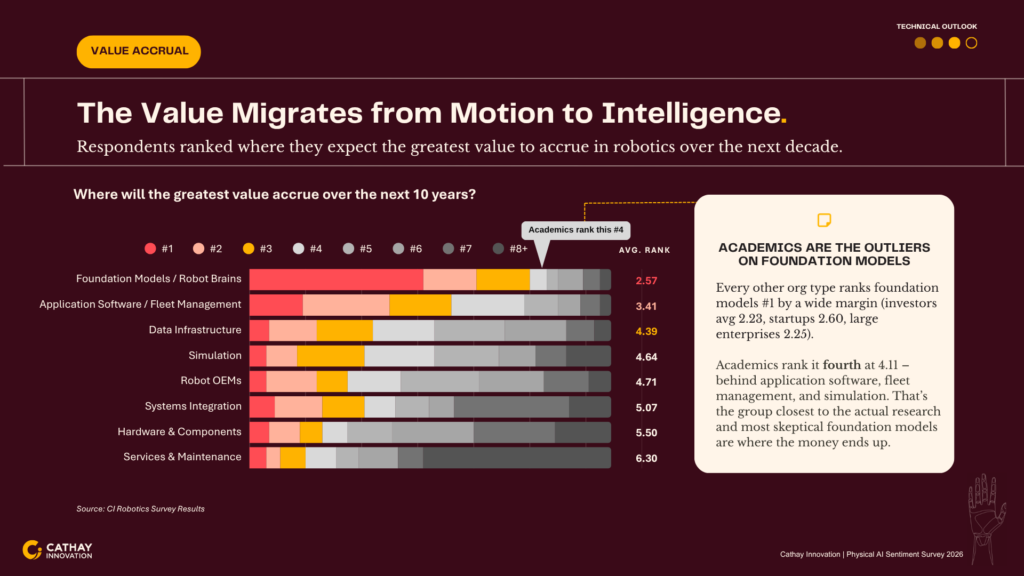
When asked where the greatest value will accrue across the robotics stack over the next decade, respondents predictably gravitated towards the intelligence layer, with foundation models coming in first by a wide margin followed by application software and well ahead of hardware, OEMs, integrators, and services and maintenance.
The interesting exception to this trend is the group closest to the actual research – academics. From investors, startups to large enterprises, academics were the one segment that didn’t rank foundation models first, instead placing it fourth behind application software, fleet management, and simulation. The group with the least commercial stake in the answer is also the most skeptical that the money ends up where the software thesis says it will. Or perhaps academics are simply just being academics — insisting they aren’t in it for the money!
The signal: the intelligence layer thesis is close to consensus outside the lab, and far less settled inside it.
5. Hybrid stack wins near-term.
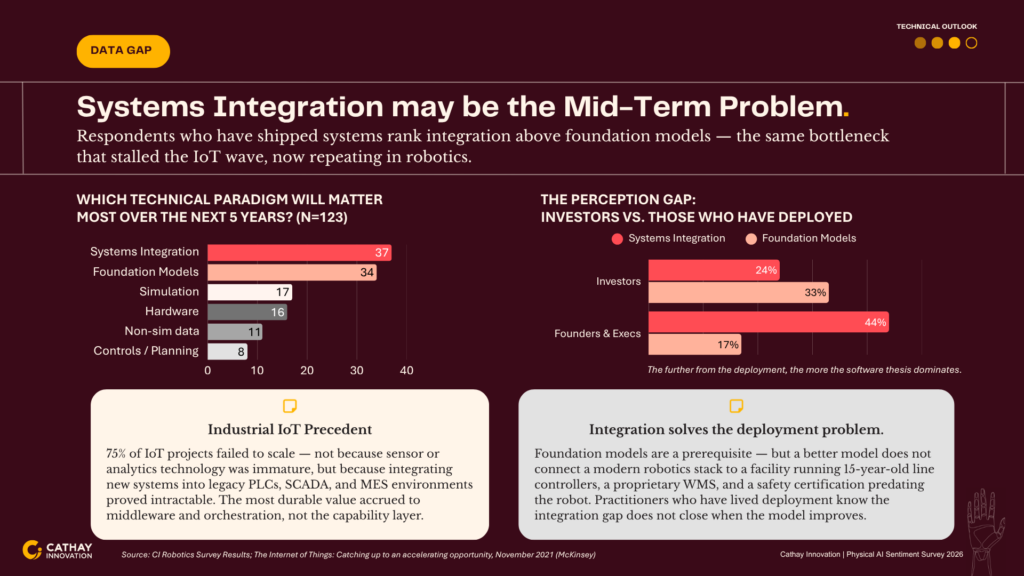
Last, yet perhaps most important, what becomes the critical unlock to this soon to be Trillion-dollar deployment problem? When asked exactly which paradigm will matter most over the next five years, systems integration (37%) and foundation models (34%) came in essentially tied, well ahead of the rest of the field (simulation, hardware, etc.). Foundation models are still in focus, but they have a less sexy compatriot contending for the top spot.
Even more fascinating is when you break this result down by either side of the equation, investors vs. builders. Investors favor foundation models over systems integration by nine points (33% to 24%) while founders and executives who’ve actually shipped systems flip that relationship hard, favoring integration over foundation models by twenty-seven points (44% to 17%). The further you are from the deployment, the more the foundational model thesis dominates. The closer you get to the bots, the more integration looks like the real bottleneck. It’s a strong echo of the last major industrial automation wave: 75% of Industrial IoT projects failed to scale within two years of initial deployment not because the sensors or analytics were immature, but because integrating new systems into legacy PLCs, SCADA, and MES environments proved intractable (McKinsey). The durable value in that cycle went to middleware and orchestration, not the capability layer.
The signal: the people who’ve actually deployed robots are telling us, fairly directly, that a better model still won’t solve their hardest problem.
Where we land.
local peak in interest and hype. The capital and the headlines, still focused on major model labs and vertical providers, have gotten ahead of deployment reality. Closing that gap is likely to take years with respondents estimating industrial mass adoption coming in 2030.
In between, the less glamorous work will need to continue: integration into facilities running decades-old infrastructure, a genuinely massive data-mining and labeling effort to close the long-tail gap, simulation infrastructure to augment data that doesn’t yet exist, and continued refinement of targeted tasks for deployments.
Only once that stack is done do we get to the version of the future everyone is envisioning: truly general purpose robots, something like Wall-E quietly doing the dishes, or C-3PO handling the hotel check-in. And hey, that’s a real destination that exists outside the wonderful world of Disney, just not in the near-term according to those on the ground.
If deployment doesn’t catch up to capital and hype on a reasonable timeline, expect a familiar correction: a trough of disillusionment, with the startups furthest from real deployment revenue and thinnest on runway weeded out first. What likely survives is a more rigorous, standardized way of benchmarking performance, both at the model and specific task layer. We wouldn’t be surprised to see further consolidation trend toward verticalization, labs and integrators moving to own or deeply partner with the end customer rather than selling a horizontal capability into someone else’s stack. It’s a pattern we’ve watched play out before, in the large language model market.
If any of the above sparks your interest, please feel free to take a read through the full report linked below. As always, if you’re building in or around this space – we’d love to chat!
methodology: In May 2026, Cathay Innovation surveyed 135 robotics practitioners — investors, founders, operators, and academics — on deployment timelines, form factor adoption, and where value will accrue across the industry over the next decade. Respondents skew toward the US and Canada. This is not a statistically representative sample of the global robotics industry; results should be read as directional practitioner sentiment.