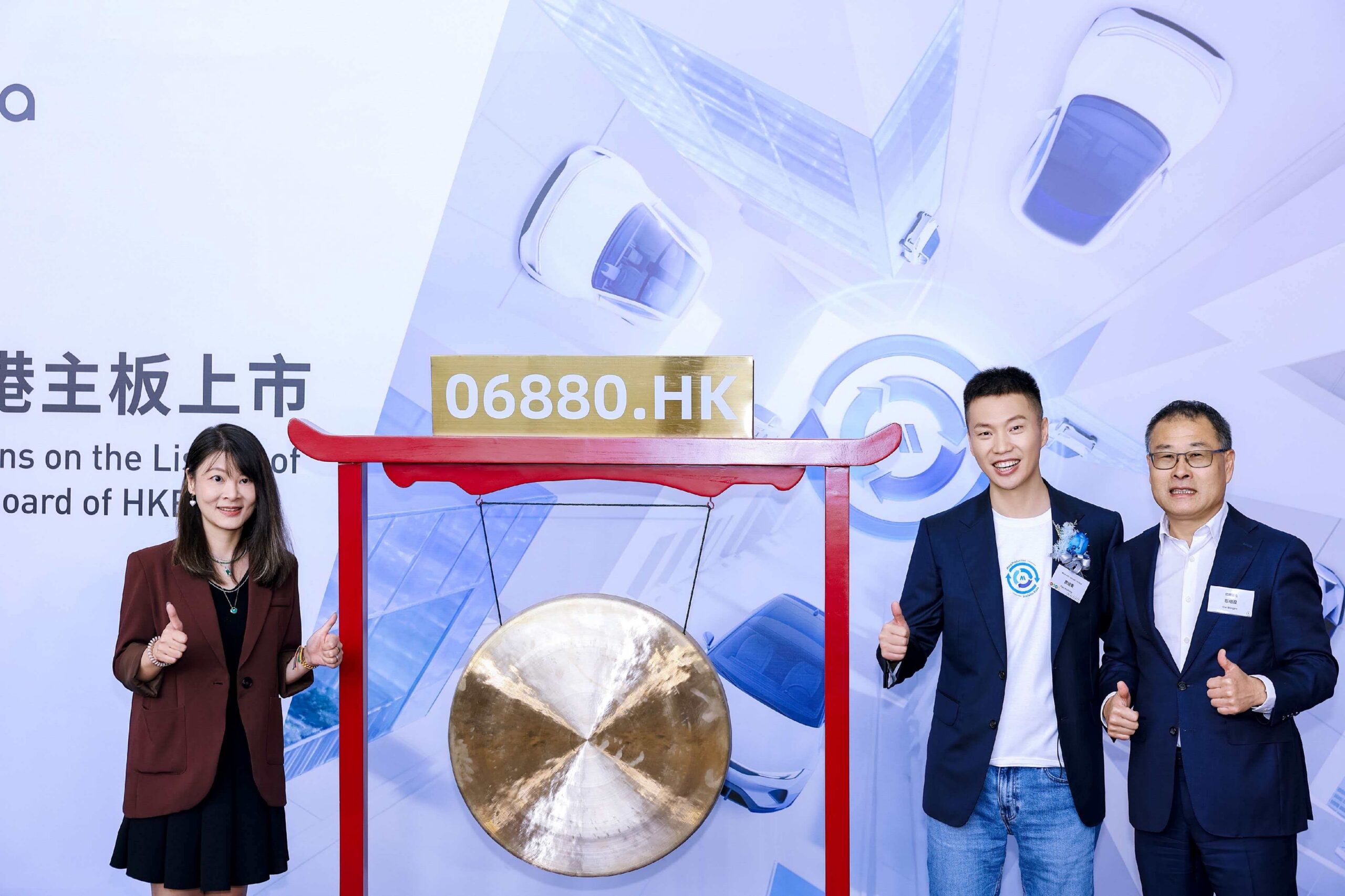
Some may recognize Momenta as a household name in the autonomous vehicle market. Others may know it as the force behind the transformation of globally leading automakers like Toyota, Mercedes or BMW.
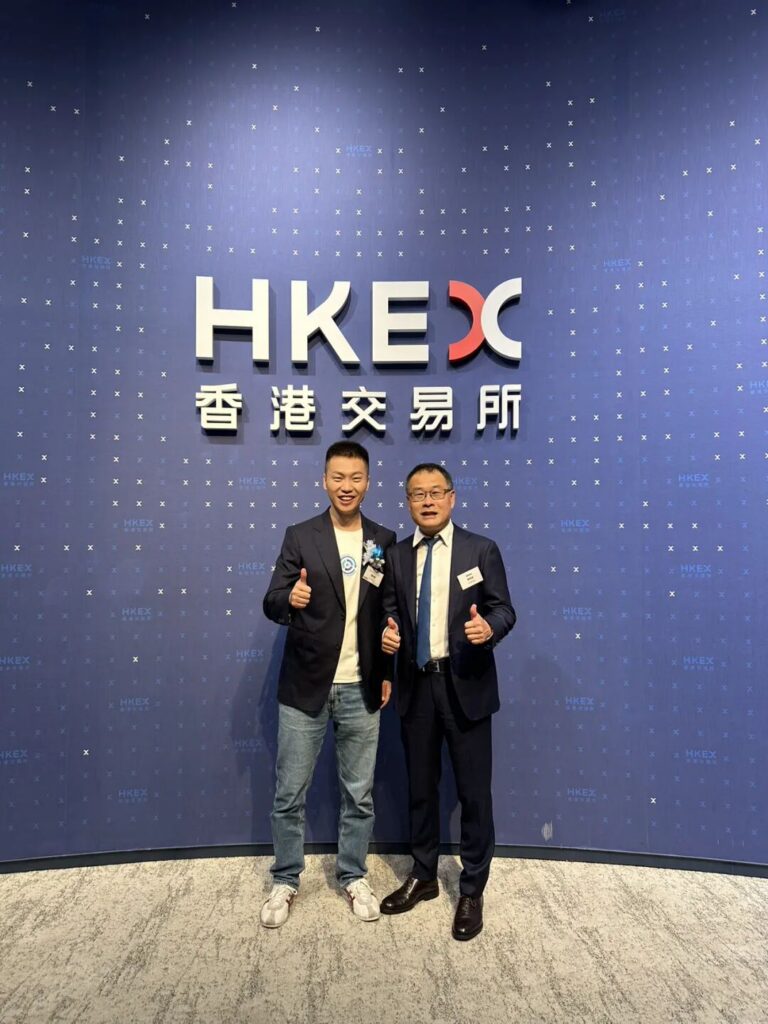
The listing marks a major milestone for Momenta, for founder Xudong Cao, and for the team that spent a decade building what started as a computer vision startup into one of the world’s leading physical AI companies. It’s also a milestone for us at Cathay Innovation. We led Momenta’s Series B2 round in October 2017, backing a team of AI scientists a little over a year into building the company, at a time when autonomous driving was far from an obvious bet.
Today, we’re reflecting on that decade: the industry perspective that gave us early conviction; the cycles autonomous driving has moved through since; and what Momenta’s path tells us about where this technology goes next.
“As committed long-term investors, we’re honored to have continuously supported Momenta throughout the most turbulent decade in autonomous driving. We have witnessed the team use extraordinary strategic focus and exceptional R&D capabilities to gradually refine its ‘world model’ into a formidable commercial moat in Physical AI. Autonomous driving is a critical pathway toward building the intelligent society of the future. We look forward to seeing Momenta continue to draw on its technological capabilities, mass-production expertise, and global ecosystem to advance the global Physical AI industry.”
— Mingpo Cai, Founder and Chairman of Cathay Innovation
Autonomous driving is a uniquely difficult business to underwrite. Unlike most software, it doesn’t get to fail safely: every model has to work in the physical world, in real time, under conditions no lab can fully simulate, from rain and construction to a pedestrian stepping off a curb or another driver making an unpredictable choice. That difficulty is exactly what has made the space swing between extreme hype and deep skepticism over the past decade.
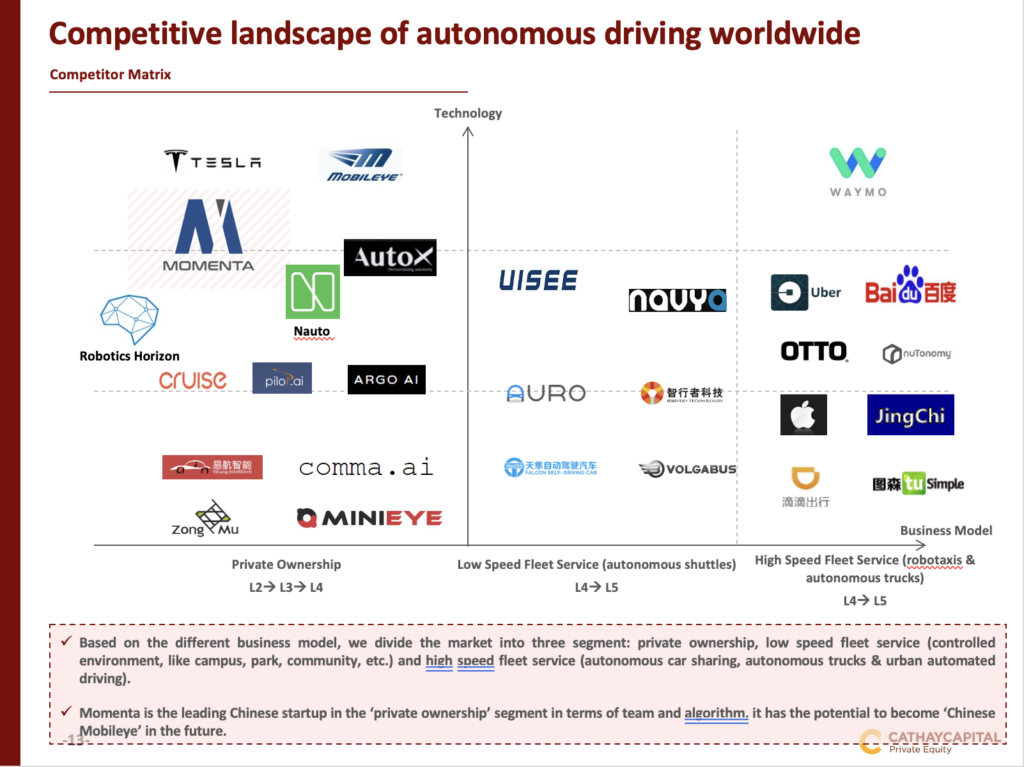
Back in 2017, the industry was near peak optimism. Tesla had pushed Autopilot into production vehicles, Google’s self-driving project had just become Waymo, and Uber, Cruise, and Argo AI were racing to build robotaxi fleets with enormous capital and top talent.
The industry’s dominant question: who would remove the steering wheel first?
That optimism gave way to a sobering reality: autonomous driving wasn’t a lab problem, it was a long-tail problem. High-profile safety incidents forced the industry to confront the gap between assisted driving and full autonomy. Robotaxi timelines that once promised city-wide coverage within a few years kept slipping. Uber folded its self-driving unit into Aurora, Argo AI shut down, and Cruise faced a serious regulatory setback after a safety incident. For a stretch, autonomous driving went from the hottest category in tech to the one that tested investors’ patience the most.
But the pullback wasn’t the end of the story: it was the industry maturing.
The years since have brought back real momentum built on steadier foundations. Waymo now operates across 10+ U.S. cities, with San Francisco remaining one of the most visible proving grounds for driverless cars. Tesla has expanded its robotaxi service and Amazon’s Zoox is moving toward large-scale production. In Europe, the UK’s Wayve raised $1.2B ($8.6B valuation) and is preparing to launch robotaxis with Uber in London and 10+ global markets.
In this global landscape, Momenta carved out its own path. Rather than making overpromises around full autonomy, it took the more grounded approach, albeit a more demanding entry point, of mass-produced assisted driving.
Momenta: Starting with the Brain.
Founded in 2016, Momenta builds the software “brains” behind autonomous driving, and runs two connected lines of business it describes as “one flywheel, two legs.”
Mass-production: licenses L2 driver-assistance systems, most notably Urban NOA (navigate-on-autopilot) to global automakers, embedded directly into production vehicles on the road today.
Scalable Robo: covers Robotaxi, RoboDelivery, and RoboTruck: Momenta’s longer-term push toward full autonomy.
The connective tissue between the two is data.
Every mass-production vehicle on the road generates real-world driving data, which feeds the models that power Momenta’s more ambitious robotaxi ambitions, which in turn improve the mass-production product. It’s a flywheel, not two separate bets.
THE TECH
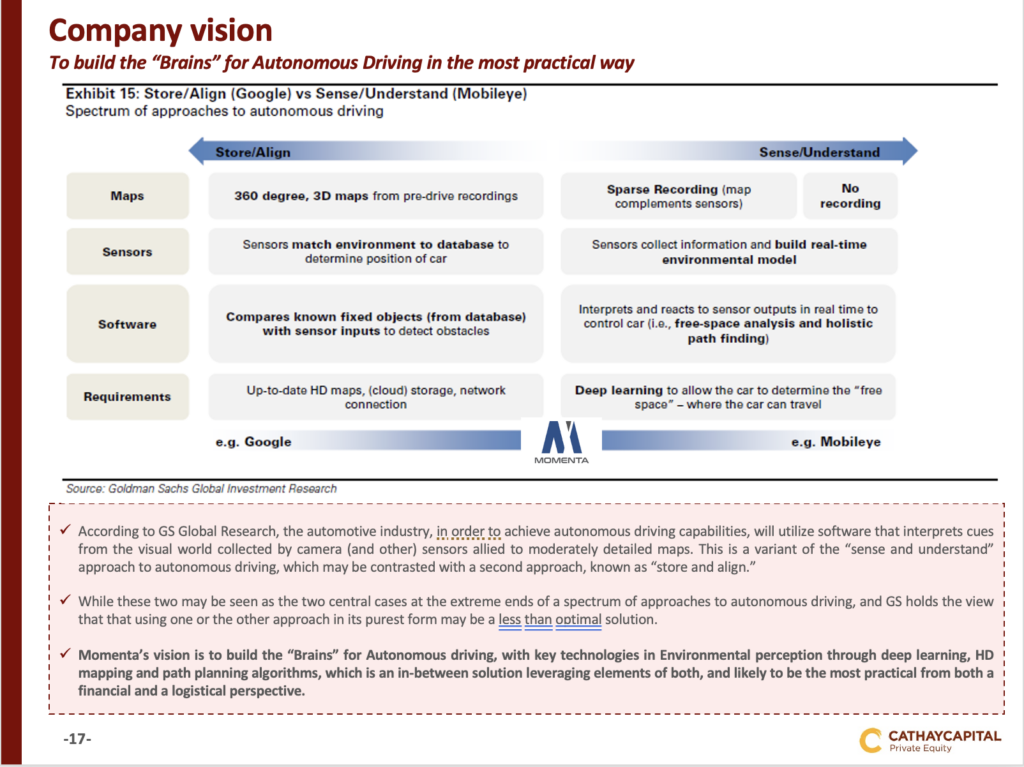
What makes Momenta different is a data-driven, map-free approach: rather than relying on painstakingly pre-mapped HD maps of every city and road it operates in (an approach some competitors depend on), Momenta’s systems learn to generalize from real-world driving data.
That philosophy has produced a string of industry firsts:
–> First company globally to deploy deep-learning-based algorithms in mass-produced passenger vehicles (2023)
–> First independent provider to commercialize an end-to-end autonomous driving system (2024)
–> First independent provider globally to bring reinforcement-learning-based models into mass production (2025), now on its sixth generation (“R6”)
THE TEAM
Momenta was founded by Cao Xudong, a former Microsoft Research Asia scientist who led a roughly 100-person research team as Executive Director of R&D at SenseTime before striking out on his own. Fortune has named him one of its “40 Business Elites Under 40” twice, in 2019 and again in 2024. His early technical core included Gang Sun, who had previously built Baidu’s Minwa supercomputer, at the time the world’s largest deep-learning training platform, and by 2017 the broader team had already taken top honors at some of computer vision’s most competitive benchmarks, including the 2015 ImageNet challenge (object detection, image classification, and scene classification) and the 2015 MS COCO Challenge.
Today, Momenta is a genuinely research-heavy organization: As of 2025, it employs 1,157 engineers and technical experts, more than 80% of its total workforce, over two-thirds of whom hold master’s degrees or above.
THE VISION
Rather than treat full autonomy as a single leap, the team built around a simple idea: autonomous driving is fundamentally a data problem, and the fastest way to collect real-world data at scale is to get assisted-driving systems into production vehicles as early as possible, then use that data to keep pushing toward full autonomy.
This is the company whose earliest version we backed in 2017: a small, deeply technical team with an unusually clear point of view on how autonomous driving would actually get built.
Industry Conviction.
At Cathay Innovation, we led Momenta’s Series B2 in October 2017, out of our Fund I (2015 vintage) alongside GGV Capital, shortly after the company had closed a $46M B1 round.
Cathay Innovation + Momenta
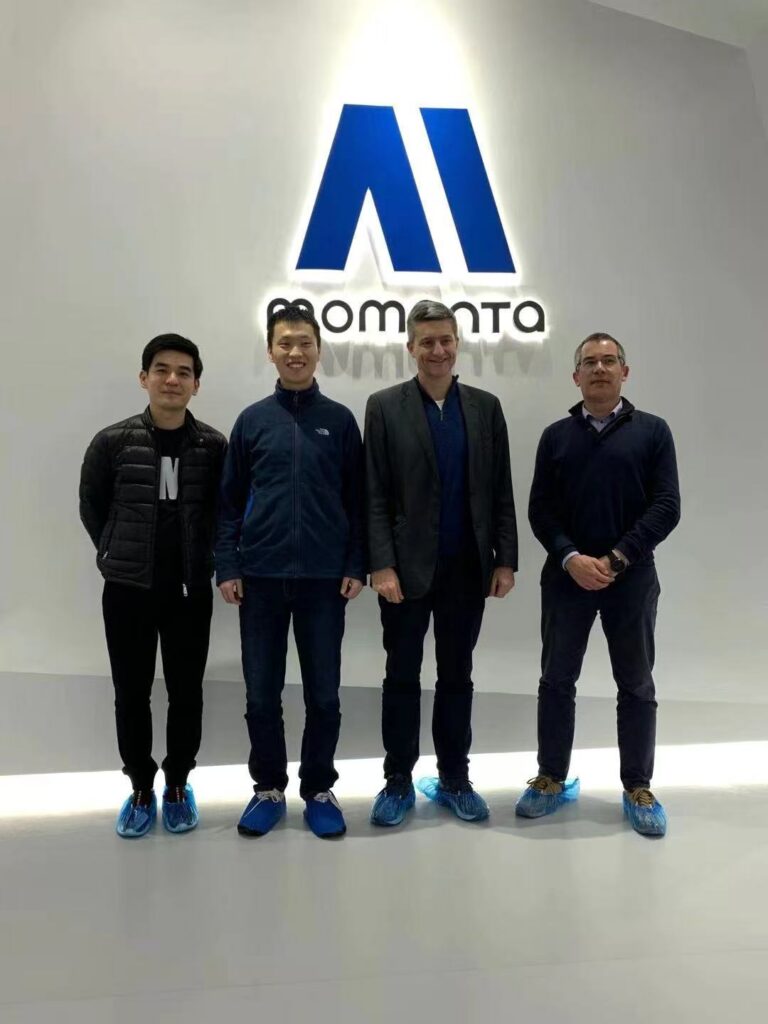
That year, we were working closely with global auto supplier Valeo (a longstanding industry partner and investor in our funds), studying the future of the car in China. That is how Momenta first appeared on our radar. We began following the company in February and by June were in the room for a live product demo alongside Valeo’s China R&D lead and an AI expert from its Paris headquarters, watching the team’s early perception, HD mapping and prototype vehicle work firsthand.
This is the model we have built Cathay Innovation around: connecting startups with industry partners who can sharpen diligence, open doors and help companies scale faster. Cao Xudong has credited our ecosystem, including partners such as Valeo, Michelin and TotalEnergies, with helping Momenta build credibility with international automakers early.
Those industry ties helped us see autonomous driving beyond the hype cycle: not as a science project, but as the AI revolution arriving in one of the world’s oldest industries.
Since 2017, we continuously supported the Momenta team, including in its 2021 Series C rounds and throughout the volatile decade that followed.
The Impact.
Just one year after our investment, Momenta became China’s first autonomous driving unicorn and one of only a handful of AV unicorns anywhere in the world.
Fast forward to the end of 2025:
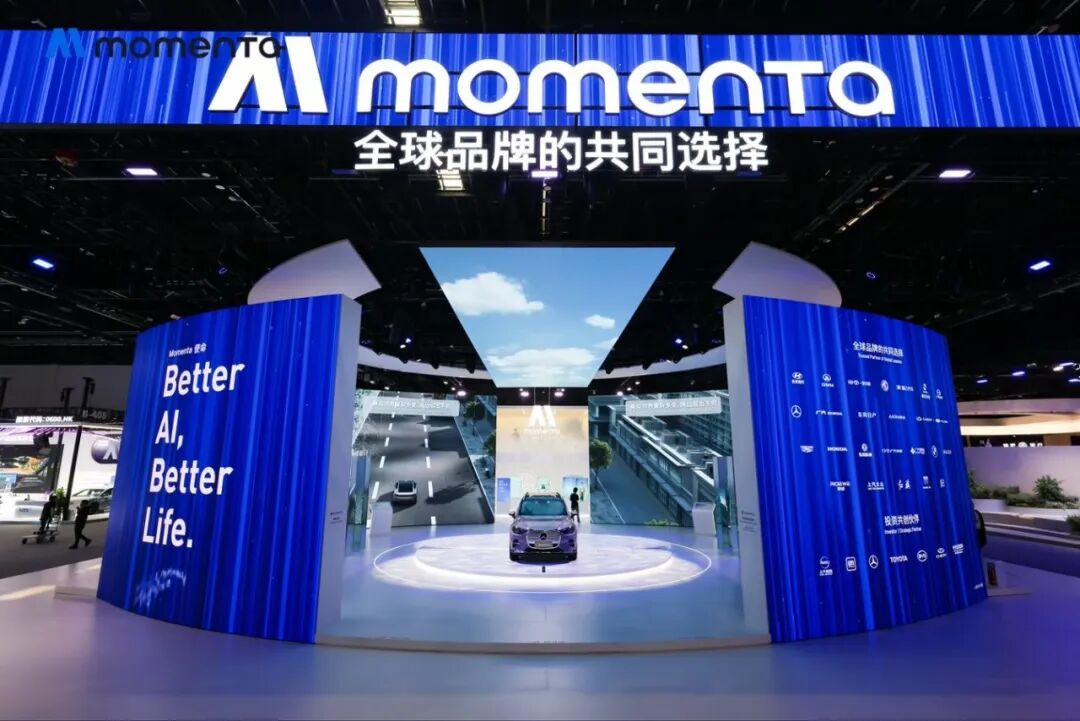
→ Momenta had partnerships with 24 global OEMs, including nine of the world’s ten largest automakers by volume (Toyota, GM, Mercedes-Benz, BMW, Hyundai-Kia, Volkswagen, BYD, Honda, and Ford, alongside major Chinese OEMs including SAIC, GAC, Chery, and Geely).
→ It had more than 680,000 vehicles on the road running its solutions.
→ It’s the #1 independent provider of Urban NOA globally by sales volume, with roughly 65% share among third-party providers. That’s about three times the sizeof the next largest player.
A snapshot of the journey:
2016: Momenta is founded by Cao Xudong, built around a vision to create the “brains” for autonomous vehicles
2017: Unveils its first modified autonomous prototype vehicle
2022: Core data-driven model enters mass production
2023–2025: Deploys deep-learning, end-to-end and reinforcement-learning-based models into mass-produced vehicles
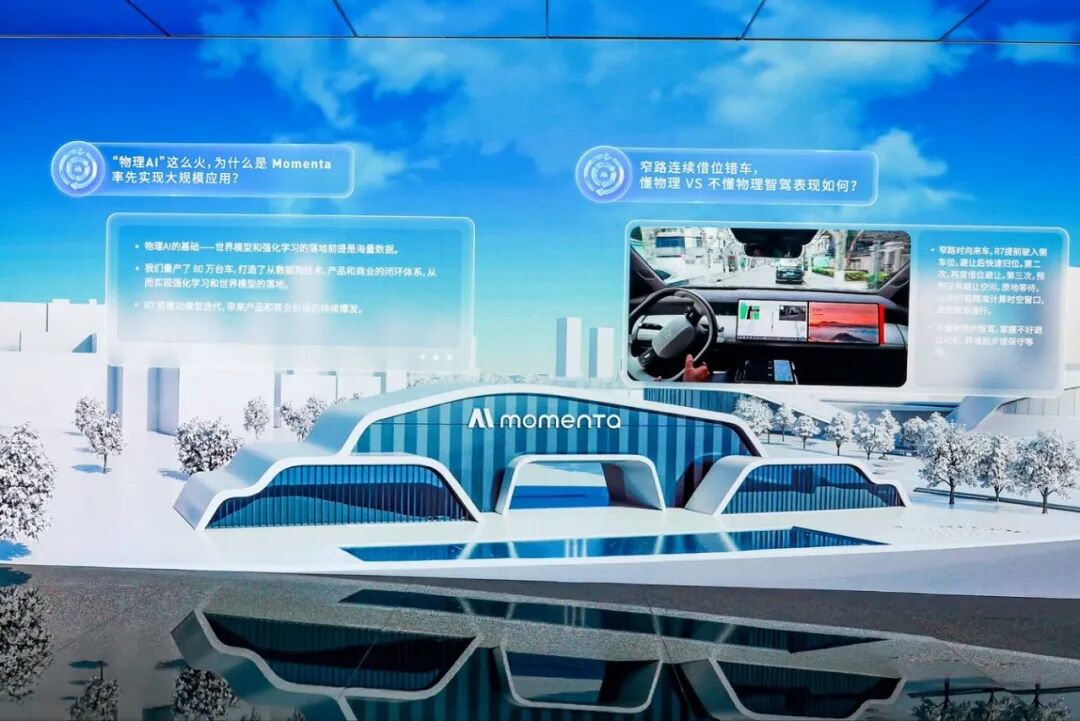
April 2026: Unveils “Momenta R7” under the banner “Physical AI Prologue” at the Beijing Auto Show
More importantly, this path hasn’t stopped at the car.
Xudong Cao (Momenta) & Mingpo Cai (Cathay Capital)
What’s Next.
At the 2026 Beijing Auto Show, Momenta outlined how its progress in world models and physical AI builds on the same data flywheel it has run for a decade. In this view, a world model creates value not through perception alone, but by learning from real driving data: physical laws, common sense, cause and effect, and how its own actions change the world. Reinforcement learning then sharpens those decisions in a high-fidelity virtual training environment.
As autonomous driving shifts from seeing the world to understanding it, Momenta’s decade of real-world data and mass-production experience is becoming one of its core assets for the physical AI era.
Parting Thoughts.
The next decade will be when we see AI truly enter the physical world.
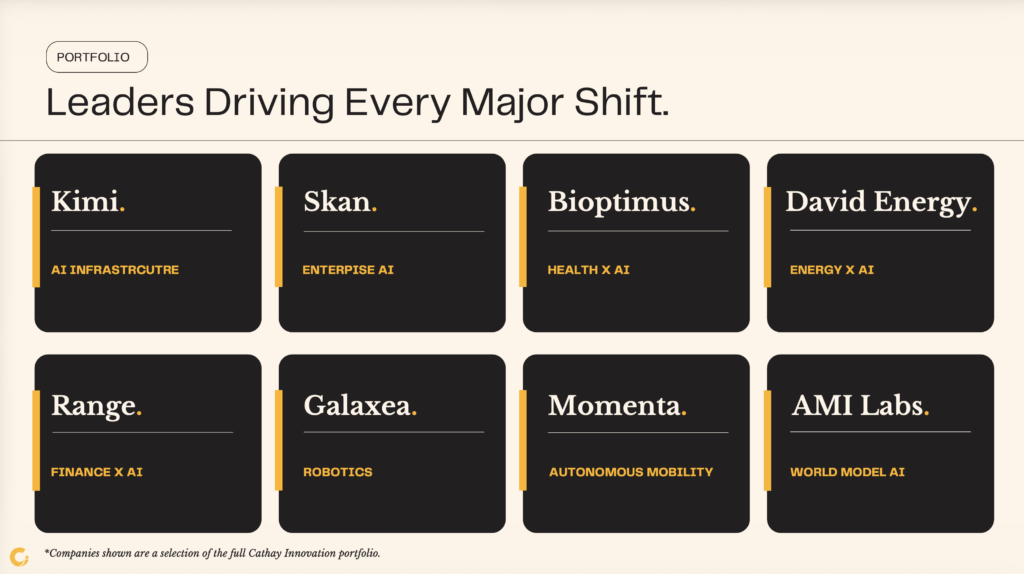
We’ve continued to back that broader thesis across our portfolio, backing companies like AMI Labs (world model AI) or Galaxea (next-gen robotics). Just as Momenta was an early leader in the automotive industry’s AI revolution, we’re committed to backing those at the forefront of every major shift – from Moonshot AI’s (Kimi) groundbreaking open-source AI model to Bioptimus’ world model for biology or Range’s AI wealth managers.
Cathay Innovation Portfolio Selection
Momenta’s IPO isn’t the end of this story. It’s a checkpoint. Nearly a decade ago, we backed a small team of AI scientists because we believed they could build the brains for a car. That team won the trust of global automakers and connected mass-produced assisted driving with fully driverless technology.It has been a privilege to stand alongside Momenta on this journey. Now, as a public Physical AI company, we look forward to what comes next.